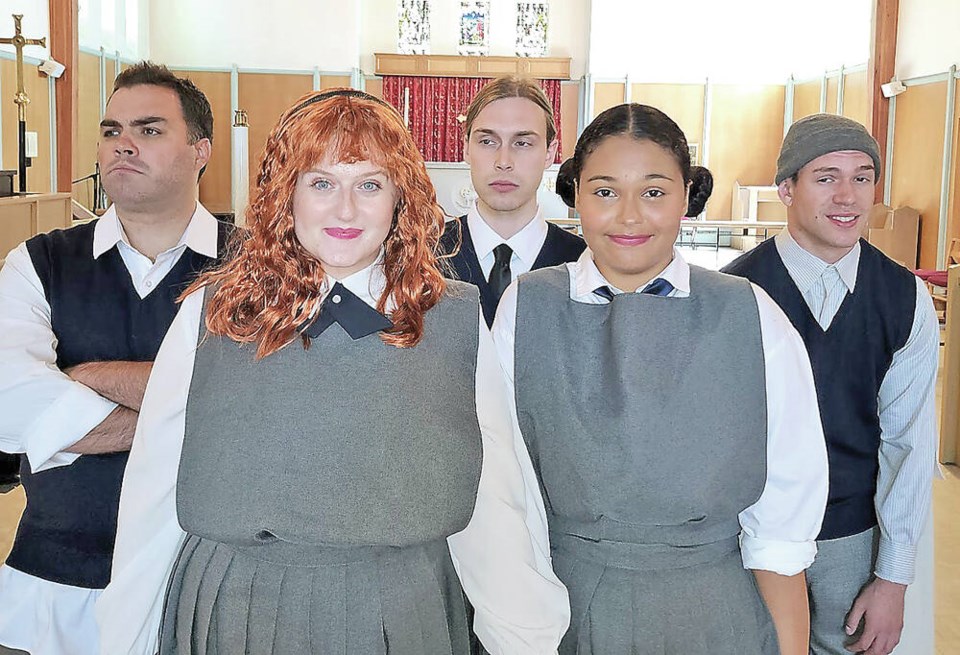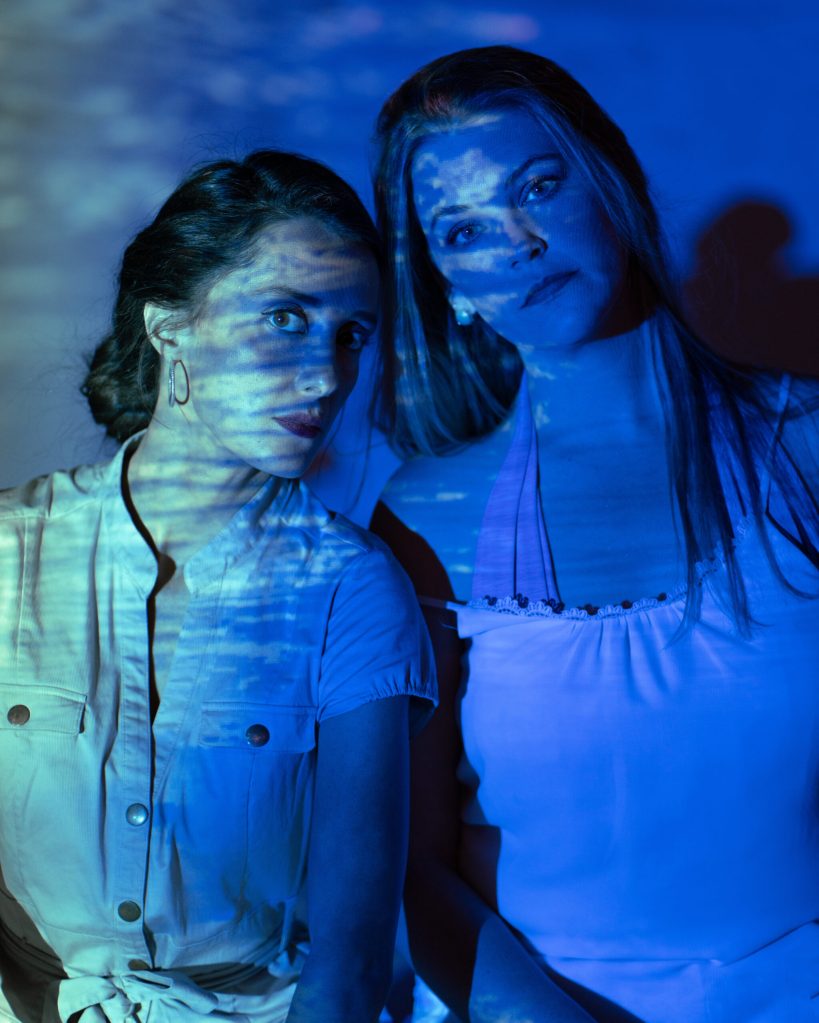
The Black Rider at Theatre Inconnu

Above, cast of The Black Rider (photo by Clayton Jevne)

Well, it is not your typical Christmas Holiday fare, but you could do a lot worse than take yourself to see Theatre Inconnu’s production of Tom Waits’ and William Burroughs’ 1993 musical The Black Rider. The plot is based on an early 1800s German folktale titled The Fatal Marksman, a familiar twist on the sell-your-soul-to-the-Devil trope so popular in literature and art. Young Kathchen (Melissa Blank) has fallen for a clerk, Wilhelm (Nicholas Guerreiro), but father Bertram (Cam Culham) insists that his son-in-law be a hunter, so Wilhelm falls into the clutches of Pegleg (Rosemary Jeffery) who provides him with magic bullets that lead to his success at winning Kathchen as his bride. But the twist in the tale leads to inevitable tragedy.

All of this is supported by Waits’ songs and Burroughs’ poetic text, written in rhyming couplets. The music features a couple of memorable tunes, “The Briar and the Rose” and “I’ll Shoot the Moon” are two that stuck in my head after the show. Director Clayton Jevne has cast the show very well, and as usual makes the most of the small stage in Paul Phillips Hall. Here, he’s supported by movement coach Sylvia Hosie, who creates some good effects with simple gestural motions rather than full-on dance. The set, designed by Jevne, works well, with shimmery translucent legs on each side of the stage, and a shadow theatre in the rear that is used effectively in multiple ways throughout. The costumes by Linda MacNaughton work well, capturing the early 1800s period.

While everyone in this nine-person cast has a standout moment or two, I want to highlight three actors who really impress. First is Nicholas Guerreiro, who shines in his role as Wilhelm, capturing well the manic intensity of a man who has given himself over to the dark side. Guerreiro is all arms and legs and makes the most of his lanky physicality in the role. Next is Ian Case, who plays multiple roles including Wilhelm’s uncle, the Duke’s messenger, and my favourite, William Burroughs himself. Case is an excellent actor, and he nails each of these characters with economy and precision. Finally, I was blown away by Rosemary Jeffery’s portrayal of Pegleg. She plays the part with great gusto, cackling with delight as all of her nefarious plans fall into place. The company all wear German Expressionist style pale face makeup, which heightens the theatricality throughout.

My one regret about this excellent show is that it lacks live music. While Brooke Maxwell has created an effective soundtrack (although not nearly as edgy as Waits’ original recording), I did miss seeing a live band perform. That said, this is an excellent production, and one you only have until next weekend to catch. Highly recommended. Tickets are available online at theatreinconnu.com.

Ian Case as William Burroughs (photo by Clayton Jevne)

Nicholas Guerreiro as Wilhelm and Rosemary Jeffery as Pegleg (photo by Clayton Jevne)

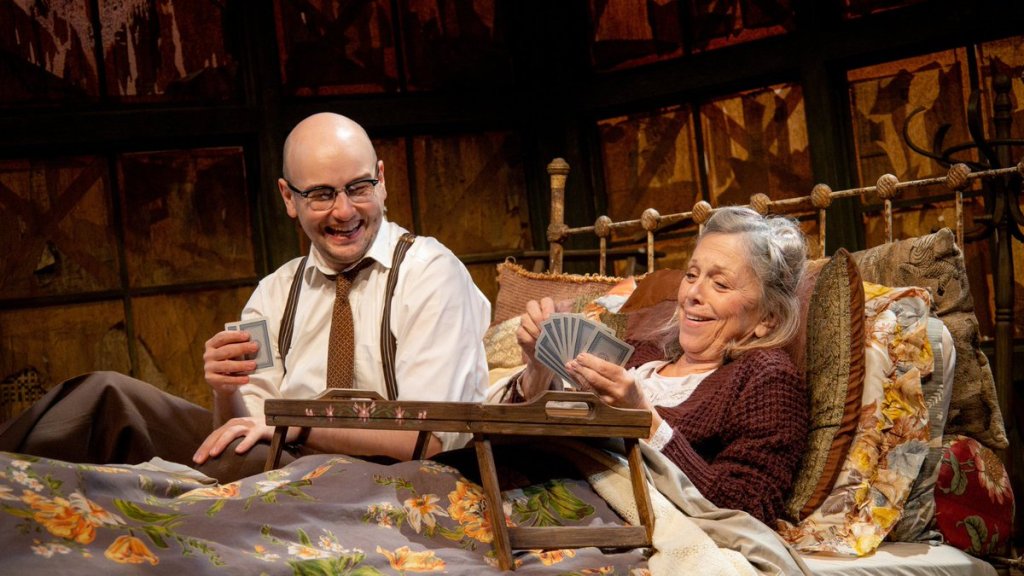
Vigil at the Belfry Theatre

I was very pleased to see the production of Morris Panych’s early play Vigil, on now at the Belfry. I have read but have never before seen this play, and it’s a good one, from one of Canada’s best playwrights. The plot is simple: a man named Kemp (Anton Lipovetsky) arrives at his sick aunt’s home, supposedly to care for her, although he seems more interested in her shuffling off this mortal coil. The aunt (Nicola Lipman) fails to deliver on this promise, so a year passes by before a terrific plot twist turns everything upside down. All of this is delivered with dollops of Panache’s black humour, reminding me in moments of Beckett in its casual existential despair, especially when Kemp keeps hinting out loud that his aunt is taking too long to die. Both actors in this two-hander mine the script for all of its comic potential, with Lipovetsky playing Kemp as a Panych-like stand-in (the playwright played the role in Vancouver and Calgary) with both acid wit and a dose of pathos too. Who is this strange man? Why has he dropped everything to come and live with his long-lost aunt? He tells us that his aunt has been out of his life for decades, and we get no closer to understanding his decision, not that it really matters. As he attempts to care for her, with endless trays of butterscotch pudding, a homemade device to help her commit suicide (which backfires on Kemp, of course!), his playing of old records and searching for photographic evidence that his aunt cares about him, Lipovetsky manages to build some empathy from the audience. This is quite a dramatic feat, as he is not a very likeable character, awkward and alone in the world as he is, but Panych does the unexpected here. And Nicola Lipman does wonders in her almost silent role as Grace the aunt. Her reactions to Kemp throughout are priceless, and the few lines she does have are delivered with full comic force.

Director Glynis Leyshon is in her element with this play, as comedy is her directorial strength, and she keeps us engaged throughout. Leyshon is well-supported by Ken MacDonald’s set design (as Panych’s partner, MacDonald has designed most of his shows) where we enter an off-kilter warehouse-like attic apartment, with paper over the windows, hermetically sealed off from the world. Tobin Stokes’ sound design also adds to the proceedings, offering music that supports rather than competes with the play. Finally Luc Prairie’s lighting works well to define this odd world and its two inhabitants. Runs until December 11th with tickets at www.belfry.bc.ca. Highly recommended.

[Images, top: Anton Lipovetsky as Kemp; bottom, Anton Lipovetsky as Kemp and Nicola Lipman as Grace (photos by Emily Cooper from Belfry website).]

The Incredible Glowing Woman and Frozen River: Two in Victoria

Poster for The Incredible Glowing Woman (hapax theatre website)

I have seen all three of hapax theatre’s shows this year, and am impressed by the quality of the work and the commitment to nurturing local plays and playwrights that Artistic Director Heather Jarvie and Production Manager Chad Laidlaw are demonstrating. All three plays this season are by local women playwrights. This final production is by Ingrid Moore and tells the fascinating and true story of women who were afflicted by radium poisoning due to working with radium paint in a clock factory in America in the 20s and 30s. You can read more about this historical event here: https://en.wikipedia.org/wiki/Radium_Girls.

In Moore’s retelling, local girl Ruth meets Anna at the Radium Dial Paint Factory and they fall in love. Ruth has seen Anna aglow with the radiation effects of the paint, and romanticizes this encounter. Ruth’s former lover has died of what the factory claims was syphilis, but as Ruth sickens, the women come to learn that it is the paint itself that is poisoning them. Added to the cast are the factory owner Mr. Kelly (Chris Salt), and Anna’s mother (Wendy Magahay). As usual, director Heather Jarvie pulls solid performances from her four actors, and makes the best use of the small stage space borrowed from Theatre Inconnu. While the pace could have used a bit of a lift throughout, I remained engaged by the story and angered by the knowledge that these women were exploited and discarded by their employer. The workers sued the company and won their case, gaining important labour and safety legislation as a result.

Frozen River poster (from Kaleidoscope Theatre website)

The second show I saw this weekend was a touring production from Manitoba Theatre for Young People, Frozen River. It tells a touching story, narrated by Grandmother Moon (Krystle Pederson), of the friendship between a Cree young girl Okânawâpacikêw (Wâpam) (Keely McPeek) and Scottish immigrant Eilidh (Mallory James). They make a promise to each other to spend the winter with each family. And although Wâpam keeps her promise, Eilidh fails to, leading to the end of their friendship. Jumping forward many generations to the present, we meet modern days versions of these girls, who this time follow though on the intergenerational promise.

There is a lot to like in this production, including puppets and effective shadow and video work projected onto a moon screen upstage. But I did think the show was very talky, leading some small children in the audience to become a bit restless. And although the set works quite well, with a four part modular circular stage that breaks apart to become other things, I wondered why at times these pieces were shown with legs facing the audience. I found this unsightly and for me it lessened the visual impact. That said, director Katie German does a commendable job with the three-person cast and I enjoyed the message of the play, which won the Playwrights Guild of Canada 2021 Sharon Enkin Plays for Young People Award.

Ride the Cyclone review

Cast of Ride the Cyclone: from Left to right, Matt Coulson, Madeleine Humeny, Carter Gulseth, Yasmin D’Oshun, Keith MacMillan. Missing: Anna Van Der Hooft as Jane Doe and Andrea Lemus as Karnak. Photo provided by Blue Bridge Repertory Theatre.

I have been lucky enough to see a few original casts of Broadway musicals. I saw Bernadette Peters play the Witch in Into the Woods, Patti Lupone play Evita, and the OCs of Spring Awakening and Come From Away. This is my third time seeing the hit off-Broadway musical Ride the Cyclone, 15 years after its Victoria debut. And although I was happy to see one original cast member returning here, Matt Coulson as Mischa, it is admittedly tough not to see Rielle Braid, Elliott Loran, Sarah-Jane Pelzer, Kelly Hudson and (especially) Kholby Wardell in their now somewhat iconic roles. But time moves on, and I’m happy to report that this remounted production offers a talented cast who are more than capable of tackling this high energy and audience pleasing show.

For those not in the know, Ride the Cyclone was created by Jacob Richmond and Brooke Maxwell and tells the tale of six teens who lose their lives in a roller coaster accident in Uranium City, Saskatchewan. Our narrator is Karnak (voiced by Jacob Richmond), a fortune-telling automaton, who fills us in on the accident and then introduces each victim so they can share their stories and sing their songs. The group of young people include over-achieving student Ocean O’Connell Rosenberg (Madeleine Humeny), her best friend, shy Constance Blackwood (Yasmin D’Oshun), Ukrainian adoptee Mischa Bashinski (Matt Coulson), Sci-fi dreamer Ricky Potts (Keith Macmillan), and gay Noel Potts (Carter Gulseth). The plot is driven by a contest to give life back to one person, to be voted on by all of them.

Co-directed ably by husband and wife team Treena Stubel and Jacob Richmond, with effective dance sequences choreographed by Stubel, the set design by Hans Saefkow offers us the appropriate seediness of a small town carnival and music director Jeff Poynter keeps the small band energized throughout. Standouts here include Humeny as Ocean, who ably captures the irritating qualities of someone who believes herself to be superior to all others, and Gulseth as Noel, whose song Noel’s Lament is a highlight of the show. Anna Van Der Hooft also impresses as Jane Doe, the sole unidentified victim, found without her head attached, who has a lovely soprano voice. The only note I have is about the poor acoustics in the Roxy Theatre, which made some lyrics a bit hard to hear. But it was great fun to see the show again, it holds up very well and is due for two more productions in the States next season. Get your tickets, as this is a short run, ending on the 14th. Recommended.

Original cast of Ride the Cyclone: from Left to Right, Elliott Loran, Rielle Braid, Kholby
Wardell, Sarah Jane Pelzer, Matt Coulson, Kelly Hudson. Photo from Citadel Theatre,
Edmonton.

Radio Silence and Lay Down All dogs: Two Victoria shows

From Intrepid Theatre website

Having lost my father when he was only 66, I’ve become a sucker for plays about dead fathers. Radio Silence, from Dawson City, Yukon’s Open Pit Theatre, tells the engaging and wordless story of a bush pilot and his two daughters. Set in the 1920s, we meet the pilot and his young twin daughters Ruth and Poppy. Then he tragically goes down in his plane and we see the daughters grieving at his graveside. We then jump ahead to the daughters as young women, with one of them becoming a bush pilot herself. Her plane crashes, but she survives, and it’s up to her twin to search for her and bring her safely home. In the mix here are a delightful Fox (played by JD Montgrand) who assists in the search, and a magical illuminated caribou that appears every now and then. The play also features an effective set (designed by Wonderhead co-Artistic Director Andrew Phoenix) of craggy snow covered rocks and three projection panels. The projections (designed by T. Erin Gruber) really add to the atmosphere, as do the occasional snippets of radio that tell us about important events (voiced by JD Montgrand and Brenda Barnes). Overall, I found the production to be engaging and ultimately quite moving. The co-written play, by Geneviève Doyon and Jessica Hickman, effectively tells the tale and of course the reunion of the sisters provides the happy ending we all anticipate. Closed June 11th following a sold out run at the Metro Theatre.

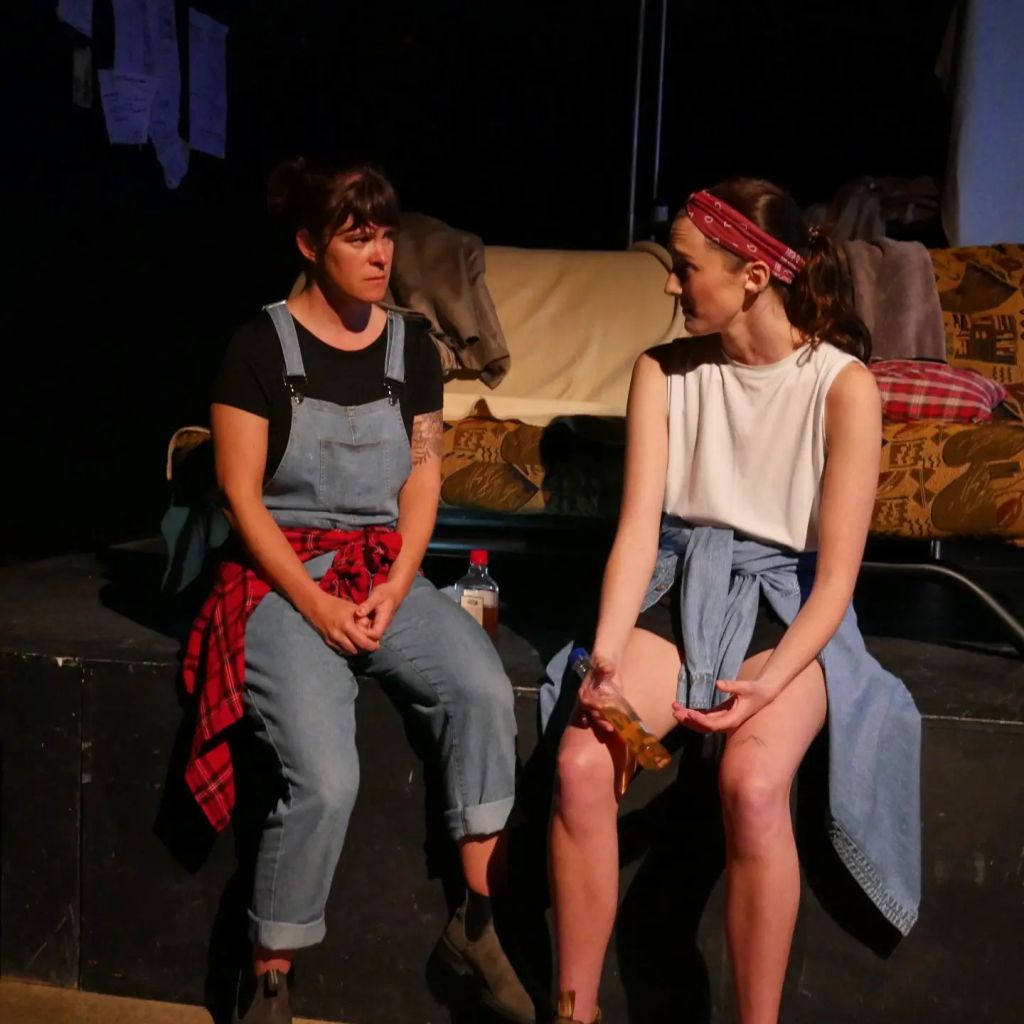
Keeley Teuber as Haven and Sarah Cashin as Jenna in Lay Down All Dogs. No photo credit provided from Facebook hapax theatre page.

Saturday night took me to the final performance of hapax theatre’s latest production, Lay Down All Dogs by local playwright Sarah Danielle Pitman. A juicy slice of Canadian Gothic, the play takes place in a deserted former windmill on the Saskatchewan prairie where sister Haven has been living and caring for her father, who has recently passed away (I can’t seem to get away from the dead father trope!) Her sister Jenna has come home from university to help her, and we immediately see the tension between these two very different siblings. Haven (Keely Teuber) is a dreamer, who wants to build a cloud seeder to bring more rain. Jenna (Sarah Cashin) is the more practical one, which we discover when she tells her sister that she put down the ailing family dog the night before, and has buried it in the garden. Into this dynamic a stranger appears, who claims to be an estate lawyer whose car has broken down. After some conversation, with Haven being particularly suspicious, we discover that the man is in fact their half-brother Brightly (Jared Gowen), born to an unknown second wife of their father’s. He is after the mill, which he wants to turn into a small country inn. The sisters resist and Haven accidentally (on purpose) pummels him with a flashlight. Believing him to be dead, they proceed to bury him out in a field, placing the dog on top. But the burial is not completed when Brightly staggers back into the house. This time Jenna does what is necessary, in their view, and murders him. The play ends with Jenna leaving, heading west or east, whichever way the coin she tosses lands, leaving her sister behind to somehow carry on.

I enjoyed this 1 hour 45 minute play, although found some of the plot a bit hard to swallow. Why would the sisters not check Brightly’s pulse after Haven injures him? What motivates Brightly to be so villainous to his half-siblings? These questions remain unanswered, which is a bit frustrating for an audience. But the show is well cast, with Keeley Teuber offering a well-rounded portrayal of troubled Haven and Sarah Cashin equally effective as Jenna. Their scenes together are some of the strongest in the show, and director Heather Jarvie mines every moment for maximum emotional effect. Jared Gowen does well in his role as the interloping brother, although again, I found his motivations to be less than clear. Another issue I had with the play is one of genre; the audience on Saturday night were laughing quite a lot, so is this a comedy or a drama? It felt to me that the playwright hadn’t made a clear decision in this regard, to the detriment of the play overall. Chad Laidlaw designed lights and sound, both of which were effectively done. There is no set design credit, but the production makes good use of the small stage space in the Paul Phillips Hall on Fernwood Road. Closed June 11th.

hapax theatre is one to keep your eye on, as I also enjoyed their previous production Castle on the Farm, a one-woman play about a young girl whose father is serving time in prison. Written by another local playwright, Alaina Baskerville-Bridges, I found the performance by Rachel Myers, who played multiple roles, to be very strong and the play was again well-directed by Heather Jarvie. It is not easy to make a go of it as a small independent theatre company. Do your part and go out to see their shows. You can find out more on their website http://www.hapaxtheatre.com/

Hedda Gabler at Blue Bridge Theatre

Amanda Lisman as Hedda Gabler and Lindsay Robinson as Eilert Løvborg
Photo credit: Jam Hamidi/Times-Colonist

Blue Bridge Theatre, under the artistic directorship of Brian Richmond, has tackled many 19th and 20th century classic plays; over the past 14 years we’ve seen solid productions of Death of a Salesman, The Glass Menagerie, Our Town, and even Ibsen’s The Master Builder. Hedda Gabler by Henrik Ibsen, first performed in 1891 in Munich, is arguably his greatest play, offering a Hamlet-like role for the actress playing the title role. In what is Richmond’s final production as AD of Blue Bridge, he offers a strong production with local Amanda Lisman as Hedda. She is a tough role to play, to say the least; great actors such as Glenda Jackson, Maggie Smith, Fiona Shaw, Harriet Walter and Cate Blanchett have played the role to great acclaim. I was not sure what to expect from Lisman, worried that perhaps her reach would exceed her grasp. But she offers an excellent Hedda; terminally bored, terrified of scandal, but deluded by the possibility of changing someone’s fate. It all spells trouble, which is exactly what unfolds.

A brief synopsis: Gabler and her husband, academic George Tesman, have just returned to their new home after a six month honeymoon. Hedda is the daughter of a general, which explains her fondness for pistols. We find out that she has not married for love, that the couple is up to their necks in debt to a local Judge, named Brack, and that she longs for some excitement in her life. Her doting husband bores her, as does everyone else she encounters, save her former lover Eilert Løvborg (Lindsay Robinson). She finds out that he is back in Oslo, having just published a book with critical success. She meets a former schoolmate, Thea (Laura Jane Tressider) who has left her husband to be with Løvborg, and has collaborated with him in writing this book and his next one. Hedda schemes to ensure that Løvborg falls off the wagon (he’s an alcoholic), then sends him off to a party that ends in the home of a courtesan. Tesman returns home from the party in the early morning to reveal to Hedda that Løvborg has lost his precious book manuscript, but he has recovered it and plans to return it to Løvborg. Hedda meets with Løvborg, who is consumed with shame and self-disgust at slipping back into his old ways. Hedda convinces him that he must make the ultimate sacrifice of suicide, insisting that it be “beautiful”. She gives him one of her pistols then burns his book. She claims to her husband that she’s done this for him, to ensure that he will receive a coveted professorship. We also learn that Hedda is pregnant, much to her dismay. We then hear that Løvborg has shot himself at the courtesan’s home and has died, but not the beautiful death Hedda wanted; rather a messy and sordid one. Judge Brack, who is trying to seduce Hedda, says he knows the pistol is hers and blackmails her to agree to his proposal of an affair. She leaves the room and shoots herself, with Judge Brack given the famous final line, “People don’t do such things!”

Lisman’s portrayal is of a woman definitely on the edge of a nervous breakdown; she twitches uncontrollably at times, her hands trembling and her face contorting into grimaces of anxiety and disgust. In this pre-feminist world, she feels trapped, and sees no way to free herself. She is an anti-hero, and difficult to like, but we can’t help but build an understanding of her anger and bitterness; life is not offering her much. Lisman commands attention in every scene, and her performance builds in power over the course of the nearly three hour long play. By its inevitable conclusion, I did feel some empathy for this woman who wants so much more than her world can give. Lisman is well-supported by the rest of the cast, with Trevor Hinton playing the naive George very well, so unaware of his wife’s unhappiness, and Lindsay Robinson playing Løvborg with an effective blend of ego and despair. Laura Jane Tressider plays Thea Elvsted with the appropriate nervous energy, although her swift recovery from hearing about her lover’s death is tricky to navigate. Jacob Richmond plays the villainous Judge Brack with oily pleasure, a bit wobbly with his lines on opening night, but convincing in his agenda to have Hedda all to himself.

The production features a very good set design by Teresa Przybylski (a wonderful designer whose work I know well from years living in Toronto, as well as here), that features skeletal trees painted in black on white backdrops. The minimal furnishings indicate the front room of the Tesmans’ home, although the sofa cushion protruding beyond the edge of the sofa drove me to distraction. Costume designs by Yi Misty Buxton, a recent grad from the UVic Theatre Department, are effective, particularly on Lisman. And I liked the spare occasional piano music underscoring certain key moments, performed by Lindsay Robinson. But I wasn’t crazy about Richmond’s decision to move the action from the 1890s to the 1920s. The flapper look on the women suggests a postwar era of more freedom for women, who were finally out of corsets after many centuries. In my view, the play works best in its own historical context, a time when women chafed against the restrictions society placed on them, including literally becoming their husband’s property, lacking the freedom to vote and being held down by domesticity. I see Hedda much as she appears in this poster from a Russian 1907 production; a product of her time, fighting against the current, yet destined for despair, and ultimately death.

https://en.wikipedia.org/wiki/Hedda_Gabler

East of Berlin and Kindred: Two in Victoria

Scenes from Theatre Inconnu’s production of East of Berlin; from left to right, James Johnson, MJ Connelly and Melissa Blank

Readers of this blog will know that I am a huge fan of Canadian playwright Hannah Moscovitch. This is the third play I’ve been able to see and review this year alone, following strong productions of Bunny in Vancouver and Sexual Misconduct of the Middle Classes at the Belfry. This play is an early one by Moscovitch, premiering in 2007. Once again, the play impresses me with its attempt to empathize with the child of a Nazi war criminal and his journey of discovery and revenge. James Johnson plays the protagonist Rudi, who is onstage for the entire 85 minute-long performance, a real achievement for a young actor with limited stage experience. While his performance was perhaps a bit one-note, he was able to convey Rudi’s confusion and anger when he discovers the terrible truth about his father’s work as a doctor in Auschwitz, conducting medical experiments on Jewish inmates. He decides to leave Paraguay, where his family fled following the war, and return to Berlin. There he meets a young Jewish woman, Sarah (played by the always effective Melissa Blank), and attempts to turn his life around. The play ends on a note of high tension, as we see Rudi return to Paraguay, perhaps to take his father’s life, or perhaps his own.

The production on Inconnu’s small stage felt a bit cramped, with fencing meant to represent the concentration camp pushing the three actors (MJ Connelly plays Rudi’s childhood friend, who spills the beans on his father’s dark past) into limited playing space. Director Don Keith adds in some movie-like music in certain scenes that I found intrusive, and overall I found the direction less than inspired. But I was happy to see yet another Moscovitch play, that reinforces my opinion that she is one of the most important playwrights in the country. The production closed on May 21st.

Illustration from Belfry Theatre website; from left to right, Stephen Lobo, Medina Hahn, Andrew McNee and Celine Stubel.

The Belfry’s final production of the season is a world premiere by playwright Rosa Dolores, Kindred. The play is about two divorcing couples, Mo (Stephen Lobo) and Soleil (Medina Hahn) and Troy (Andrew McNee) and Elise (Celine Stubel). They each have a young child. The play opens with the couples battling each other, as the wounds inflicted are recent and still raw. As time passes the situation improves, and reaches the point where Soleil and Troy meet up for a first date. While I won’t spoil what happens next, we will also see a scene late in the play bringing Mo and Elise together. Playwright Dolores’ world view seems to reflect a belief voiced by Soleil and Troy that they are ‘givers’ and their exes are ‘takers’. While this may be over-simplistic–people tend to be more complex than being reduced to one type or another–in the world of this play, it does ring true. Firefighter Troy and massage therapist Soleil feel that they have given more than they received from their former partners, and find hope in finding a fellow ‘giver’ to move on with. Takers Elise and Mo are more challenging to portray, as they appear selfish and demanding. But we soften our view of them somewhat when we see them meet up for a candid conversation. Is there perhaps a romantic spark there as well?

All four actors offer nuanced and solid performances; I particularly liked Andrew McNee and Medina Hahn’s work. I have seen McNee on stage in Vancouver a number of times, and he always appeals as a warm presence, as does Hahn here. Their long first date scene was surprisingly moving, as they trip all over themselves in holding back and then oversharing. We root for them, and the actors’ work makes us hope that they will make it together. Lobo and Stubel have to harder job here, as their characters are less likeable, but they round them out over the course of the play.

Director Lauren Taylor moves the action along well in this 90 minute long one-act play. She is supported by designer Pam Johnson’s effective set design, a house front with a revolve bringing set pieces on and off stage. While this play offers a modest ambition in its blend of comedy and drama, its pleasures overall make for an appealing good night out. Runs until June 12th with tickets at www.belfry.bc.ca.

ENDNOTE: The digital program for the production neglects to offer a note from the playwright or director on the play (or even a bio of the playwright!). I miss these elements, as they can offer insights into what I am about to see. Dear Belfry, please bring back these notes!

Four recent performance reviews in Victoria and Toronto

Daniel Okulitch as Don Giovanni, 2022. Mackenzie Lawrence Photography. From POV website.

I have seen a number of shows in the past week or so, starting in Victoria with a fine Pacific Opera Victoria production of Mozart’s Don Giovanni. We all may know the story of the inveterate seducer of thousands of women, who eventually pays the price for his lechery, ending up literally in hell (where George Bernard Shaw will follow up the story with his own postscript play). Set in modern times, the show was well-directed by Maria Lamont, who effectively brings the story into the present day. The simple sets, designed by Christina Poddubiuk, worked well, with columns and Italianate archways taking us into the appropriate setting. The lead singers were all excellent, in particular Daniel Okulitch’s rakish Giovanni, who fights to the death for his libertarian lifestyle, and Aviva Fortunata’s Donna Anna, along with Tracy Cantin’s Donna Elvira and Cecile Muhire’s appealing Zerlina, all of his rejected lovers expressing both their regret for falling for him alongside the lingering longing they cannot help but feel. The POV orchestra, under Timothy Vernon, sounded terrific, and the chorus looked and sounded dramatically caught up in the action Mozart spins so well.

From https://www.soulpepper.ca/performances/pipeline

My next show took me across the country to Toronto, and Soulpepper Theatre’s production of Dominique Morisseau’s play Pipeline. Originally produced by Lincoln Center Theater in 2017, New York City, Pipeline was commissioned by Steppenwolf Theatre Company, Chicago. With a pedigree like this, and with the subject matter of personal interest to me, I was really looking forward to seeing this production, directed by Weyni Mengesha and featuring a majority Black cast. The plot tells the story of divorced mother Nya (Akosua Amo-Adem)–whose son Omari (Tony Ofori) has gotten into trouble at school after losing his temper and pushing a teacher–and her very real fears for his future and safety in America. While Nya is a public school teacher, a tough job in America, she sends her son to a private school, and is pinning all her hopes for his future on his succeeding in that setting. The play follows this situation and introduces us to Omari’s girlfriend Jasmine (a delightfully ‘teenage girl’ Chelsea Russell), long-suffering fellow teacher Laurie (the always strong Kirsten Thomson), ex-husband and absent father Xavier (Kevin Stanchard) and school security guard, plus potential love interest for Nya, Dun (Mazin Elsadig). I found the play to be well-written and the acting competent, if not inspired, throughout this 90 minute performance. But I also found my attention drifting at times, less than captivated by what I was witnessing. I heard from a fellow theatregoing friend that the Lincoln Centre production, which was available for live streaming during the pandemic, was sensational. This production left me wanting more.

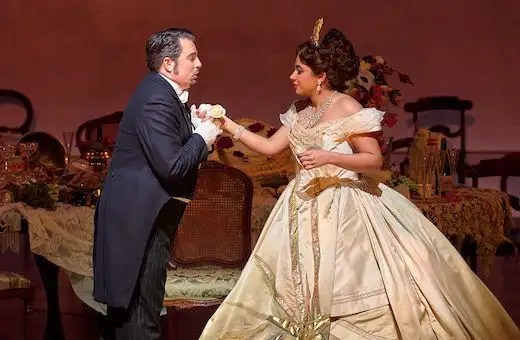
Matthew Polenzani (Alfredo) and Amina Edris (Violetta) from https://bachtrack.com/review-traviata-edris-polenzani-piazzola-canadian-opera-company-toronto-april-2022

Next, my quick trip to Toronto took me to a superb production of Verdi’s great opera La Traviata. Based on The Lady of the Camellias by Alexandre Dumas fils, it tells the tale of the tragic Violetta, a Parisian courtesan who finds true love, and an escape from the emptiness of her high society life, in the arms of Alfredo Germont. Of course, this being opera, she loses her love (for a while), and eventually her life to the great killer of the 18th and 19th centuries, tuberculosis. In this production, a remount of the same opera last seen in 2015 at the COC, director Arin Arbus captures the passion and beauty of Verdi’s music in the dramatization and especially the strong lead performances by Amina Edris as Violetta, who sang beautifully throughout, and Matthew Polenzani as Alfredo. Strong also was Simone Piazzola as Alfredo’s judgmental father Giorgio Germont. The costumes by Cait O’Connor were suitably ravishing, especially in the party scenes, with O’Connor adding some giant puppets into the mix as well, to great effect. The lighting was lovely, as designed by Marcus Doshi. The chorus looked and sounded splendid, and so did the orchestra, under the baton of conductor Johannes Debus. All in all, it was a three hour dip into an opera that is so much revived for good reason; its glorious romantic music will move you and its story of tragic love will touch your heart, as all good art must do.

From website https://showoneproductions.ca/event/library-at-night/

My fourth and final recent performance was a virtual one; Robert Lepage’s virtual reality experience The Library at Night, based on the book of the same title by Alberto Manguel. The experience is advertised as “an immersive and sensory virtual-reality journey that whisks you away to ten libraries, real or imagined, throughout time and across the globe – from Mexico to Japan, Copenhagen, Sarajevo and beyond.” Visitors are greeted by a guide who leads us into (what else?) a library, outside of which we see rain falling down the windows and hear Alberto Manguel introduce us to his lifelong love affair with libraries and everything they both hold and represent. We are then taken into another room, seated and given instructions on how to put on and operate our virtual reality headsets. The interface is quite intuitive, and I was able to navigate to the ten different library sites worldwide with ease. Each library offers a 3-D version of the library, in which the viewer can turn and look in all directions. Actors move soundlessly in and out of the space while music plays and Manguel’s voice orients us to what we are seeing. So we travel from the Ancient Library of Alexandria, to the destroyed Sarajevo Library, to the National Library of Canada (with an incredible animation emerging from the pages of Audabon’s The Birds of America (the highlight of the experience). I have librarians in my family; both my mother and my sister are retired librarians, and my sister now teaches at the UBC Library School. I have always believed in the value of libraries as bastions of knowledge-keeping and democracy–where else can you get anything in our world for free?–and this VR experience brought back to me both the beauty of libraries as architectural spaces and the profundity of what they represent for humanity and its better nature.

Sexual Misconduct of the Middle Classes Review

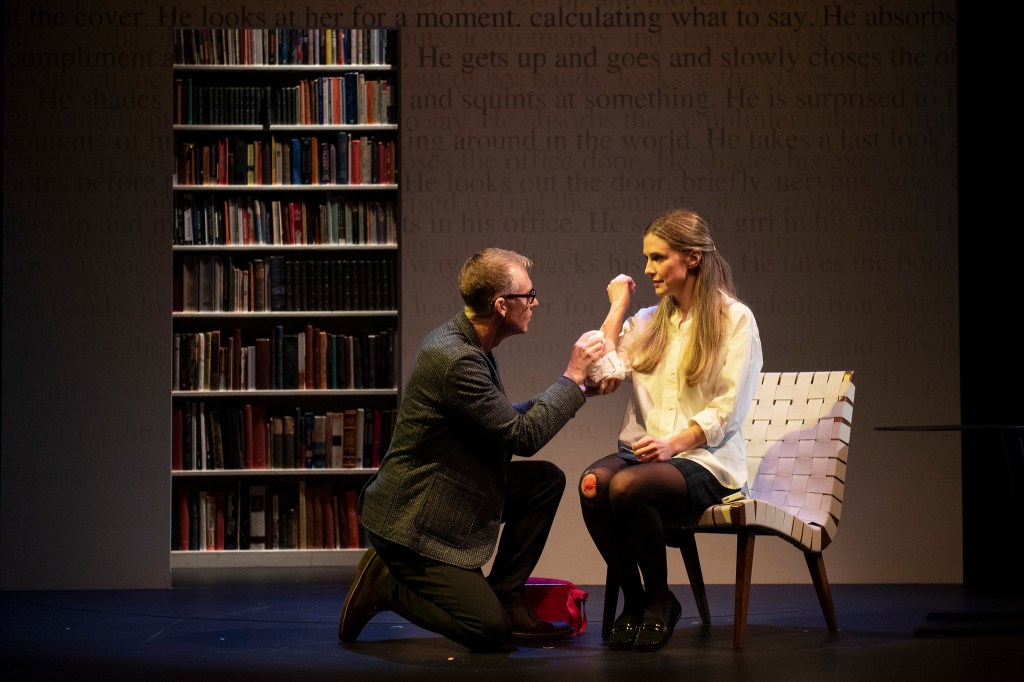
Vincent Gale (Jon) and Sara Canning (Annie) in Moscovitch play/Photo by Emily Cooper

Sometimes, writing a play can be therapeutic for the playwright. It appears this might be the case for Governor General’s Award winning playwright Hannah Moscovitch with her play Sexual Misconduct of the Middle Classes. In it, she repeats a plot line seen in her 2016 play Bunny (recently reviewed here) when a first year college student has an affair with her married professor. This 2020 play, recipient of the 2021 Governor General’s Literary Award for English language drama, centres around college professor and successful novelist Jon (Vincent Gale) and the attraction he feels towards his student Annie (Sara Canning) that tips inevitably into an affair. The 80 minute two-hander makes the interesting choice to have the story told from Jon’s point of view; he is our narrator and quite honest in his relaying of his growing feelings for Annie, although also with a large dollop of self-justification alongside his self-loathing for bedding a teenager.

Ably directed by the Belfry’s AD Michael Shamata, the two actors here offer strong and effective performances. Belfry regular Vincent Gale in particular impresses with his honest narration of losing control of the situation, but also revelling in his conquest of a beautiful young woman. Canning also impresses in her Belfry debut. Her Annie shows her falling under the spell of an author and professor she admires, to the point of seduction. When Jon accuses her of coming on to him, Canning’s response is one of baffled vulnerability, moments before Jon moves in for a kiss and the affair begins. The production has a simple but effective set consisting of a painted backdrop featuring what we imagine is text from Jon’s writing, and a revolve that swiftly moves set pieces on and off stage. Both set and costumes, which also work well, are designed by Shawn Kerwin, with sound design/composition by Tobin Stokes and lighting by Leigh Ann Vardy.

There is a twist in this somewhat familiar tale, that made me think back to David Mamet’s controversial 1992 play Oleanna. Mamet’s play, also focused on an encounter between a student and her professor in which the student charges her professor with sexual harassment, leads to a dark finale when the professor, about to lose his house and job, physically assaults the student. Here, Moscovitch’s ‘revenge’ for Annie is a softer one, but perhaps no less effective; years later (spoiler alert) she has become a successful playwright and she visits Jon in order to give him a copy of her next play. You guessed it…it’s the play we’ve been watching, consciously telling the story from his point of view. And it is this twist in the tale that affected me most; Moscovitch could obviously have chosen to tell her story from Annie’s perspective but she instead chooses to focus on Jon. There is something moving in this choice for me, to enter into Jon’s experience of the affair and to try to understand what it was, how it happened and what it meant to him. This feels like a radical form of empathy to me, and ultimately quite a feminist act. The war between the sexes continues in the age of #MeToo, but Moscovitch, in her usual intelligent way, skews the perspective to allow us to better see and understand how sexual misconduct of the middle classes works on men as well as the women they choose to love, and then leave. On until April 24th with tickets available for pay-what-you-can prices at https://www.belfry.bc.ca. Recommended.

TWO VANCOUVER PLAYS – MARCH 2022

Photos of Alexandra Lainfiesta & Genevieve Fleming by Sewari Campillo

Last weekend took me to Vancouver to see two excellent productions, Clean/Espejos and Bunny, both on at The Cultch as part of the Femme Festival of women-focused plays. Clean/Espejos is a new play by Christine Quintana, a two-hander about an encounter between a housekeeper and a tourist in a Mexican resort. Produced by Neworld Theatre and co-directed effectively by Chelsea Haberlin and Daniela Atiencia, the play examines the heavy psychological toll of abuse. Housekeeper Adriana has fled her family home and her abusive alcoholic father for a job at a resort. She meets Canadian tourist Sarah, there for her younger sister’s destination wedding. Adriana and Sarah first meet after Sarah has drunkenly hurt her knee and bled profusely into her bed. Adriana politely cleans up the mess, even though it’s not her job, as she manages the housekeeping staff. Adriana has just heard that her father has died, precipitating a powerful emotional response. Sarah is portrayed as a bit of a mess, but over the course of the play, we realize that she is coping with long-buried sexual abuse that comes to the surface in a painful conversation with her mother and sister.

Act two of this over two hour play (which could use a bit of judicious trimming), takes us into some fantasy scenes that bring our two protagonists together in scenes that we realize only in hindsight are not actually occurring, for example when they take off together to attend Adriana’s father’s funeral. These scenes may cause some momentary confusion, but do allow us to see a relationship forming between these two damaged women. The play is staged very cleverly as entirely bilingual, with both character’s speech translated into Spanish and English via video projections on the large white bed that serves as a backdrop. The set is stylized with two moveable bed-like structures on an all-white set. Actors Alexandra Lainfiesta and Genevieve Fleming offer committed performances that challenge them with the emotions they are called on to perform; Adriana’s howling grief and rage at her father’s grave was a memorable moment of rawness that will stick with me for some time. While I attended the final live performance of this play, there will be streamed performances from April 5th to 10th for $15. Recommended.

Emma Slipp as Bunny – Photo by Emily Cooper

I am a very big fan of Canadian Playwright Hannah Moscovitch. Her plays are always women-centered, smart and filled with punchy dialogue and complex characters. So it is with her 2016 play Bunny, which premiered at the Stratford Festival. Tracing the sexual history of a woman, from adolescence through to marriage and children, the play offers a huge acting challenge in the main role and some juicy supporting roles as well. For much of the play, Bunny (a nickname from her college friend Maggie), named Sorrel by her academic hippie parents, addresses the audience directly. She tells us about her first encounters with 19 boys in high school (just making out, mostly) and her first boyfriend Justin, captain of the football team (Liam Stewart-Kanigan). We see that Sorrel is an outsider, wrapped up in her love of Victoria literature, viewed as a slut by the girls at school, awkward and struggling to connect with others. College offers new vistas and is where she meets her lifelong friend Maggie (Ghazal Azerbad) and enters into an affair with a married professor (Jay Hindle). She becomes a successful professor of Victoria literature and meets Maggie’s brother Carol (Kayvon Khoshkam) who ends up her husband and father to their two children. But Bunny’s journey leads her to the edge of another affair, with a friend of Maggie’s daughter, Angel (Nathan Kay).

As ever, Bunny faces us with both bravery and vulnerability, holding nothing back. In the final moments of this moving play, her friend Maggie, dying of cancer, presses her to open up, to share more of herself. Her exclamation of love for her friend is well-earned in Emma Slipp’s affecting and intense portrayal. She is supported by a strong cast, with excellent direction by Mindy Parfitt, terrific lighting (as ever) by Itai Erdal, a slightly cramped set design by Amir Ofek and effective sound design and composition by Alessandro Juliani. There are explicit sex scenes throughout this 90 minute one-act play; the use of an intimacy coach ensured the actors felt safe, and I was interested to see there was no nudity beyond Jay Hindle’s professor removing his shirt in one scene. I stayed for the post show talkback last Sunday afternoon, and was struck by the sensitivity in Parfitt’s decision to not push audiences too much around the sex scenes, while they are just returning to theatregoing after two years. The cast spoke wholeheartedly about their commitment to Moscovitch’s play, and the support they are feeling from audiences. Another excellent work from this talented playwright, it made me look forward to the next play at the Belfry, opening next week, Moscovitch’s Governor General’s Award-winning 2021 play The Sexual Misconduct of the Middle Classes. Watch this space for my review.